Monday, 31 October 2022
JPO Spring Symphony Season: Second Week
Saturday, 18 June 2022
Two Joyful Weeks at the JPO
Reading a concert programme can give a concertgoer an advance impression of the kind of experience they might undergo. A little knowledge on the works programmed, of the soloist, and of the conductor can go a long way – and previous experience of each can go much further. But they can only go so far. No concert can be heard in advance, no feelings can be felt before they arise. And the foretold experience of a concert is a slender mirage that melts away as soon as the first real notes are played.
Take, for example, the first concert of the Johannesburg Philharmonic Orchestra’s Winter Symphony Season. I read, first, that the young Venezuelan flautist Joidy Blanco would be the soloist, playing Mozart’s Second Flute Concerto (K. 314), and that the conductor Robert Moody would then direct the JPO in Beethoven’s Seventh Symphony. The whole endeavour would be kicked off by Mozart’s overture to Cosi fan tutte. I read, second, that Blanco would be replaced at the last minute (due to travel complications) by Liesl Stoltz, the highly accomplished South African soloist whom we have been fortunate enough to hear at the JPO before, and that Stoltz would be replacing Blanco’s scheduled encore with a virtuosic showcase of her own choice.
Knowing what I know about Stoltz, Moody, Mozart, and Beethoven, I quickly drew up some ideas of how the evening would go. There would be some difficulty in the orchestra (as there invariably is on opening night) keeping precisely in sync for the Mozart. Stoltz would play decorously, and would dazzle in her encore. The Beethoven would roll out with inevitable boisterousness, just as it has a hundred times before, and would linger (uninvited) in my head for the rest of the week. (The Beethoven was last played by the JPO just eighteen short months ago.) I also harboured the quiet hope that Moody – a cheerful American southerner – would address us before taking the podium for the Beethoven, as he had done so memorably at his JPO début in 2019, conducting Brahms’s Third Symphony.
Friday, 13 May 2022
An All-Too Conservative JPO Symphony Season
Friday, 17 December 2021
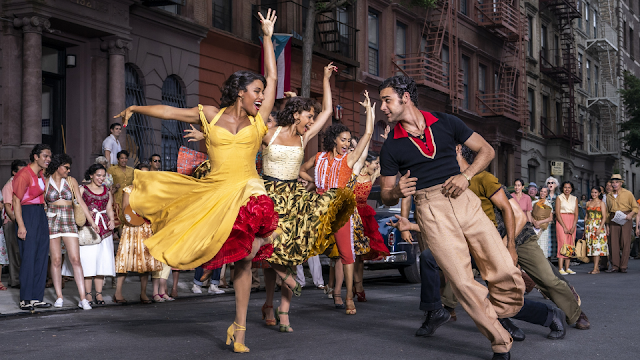
“West Side Story” 2021
Friday, 6 March 2020
A Night of Dance and Drama at the JPO
Sunday, 23 February 2020
The Metropolitan Opera’s Vital “Porgy and Bess”
As America was establishing itself as a cultural power, and setting up its institutions to garrison that culture, it conspicuously and contemptibly omitted much of black American culture and history from that sanctum. America’s hallowed depictions of itself in claimants to the Great American Novel and the Hollywood studio classics were not given to portray any African-American perspective, nor to consider the influences drawn from African-American culture or the significance of black history. George Gershwin’s Porgy and Bess is an enduringly great opera for a number of reasons, and one reason brazenly realised in the Metropolitan Opera’s new production is that it takes black history as American history itself, and it depicts the expressive and exuberant aspects of African-American life as the essence of America’s brash, new, singularly energetic place in world culture.
Tuesday, 19 November 2019
My Wishlist for JPO Programmes
The JPO’s primary function is to provide good performances of works in the orchestral repertory. But there’s an important secondary, curatorial function to any symphonic orchestra; the works that are chosen to be played are the works that are implicitly designated as important to the culture, the ones that are chosen to last. The canon is built by the decisions of what to perform, as well as by what to leave out.
For too many people, the “classical” in classical music means definitive, or etched in stone. A great orchestral performance can prove that classical also means radical: the works that have survived the ages can still yield new experiences, new visions, new worlds of feeling, and the works of today that look forward and open up music’s paths into the future yield nothing but the new.
Friday, 20 September 2019
A Very Exciting JPO Spring Season 2019
Friday, 31 May 2019
An Impressive Start to the JPO’s 2019 Winter Season
Sunday, 17 March 2019
A Wishlist of Upcoming Programmes from the JPO
Bartók: Concerto for orchestra. I’ve been tracking the JPO’s programmes since their relaunch of regular seasons in 2017, and only one-tenth of the programmed works have been composed in the last 100 years. This work premiered 75 years ago, and it remains Bartók’s most popular piece.
Stravinsky: The Rite of Spring. This work is from more than 100 years ago (but only just), though what modern classical composition has been more influential? And what could be further from the so-far solely mellifluous 20th-century works already presented, like those of Gershwin, Ravel, and Bernstein?
Friday, 15 March 2019
Highlights of the JPO’s Summer Season 2019
Saturday, 10 November 2018
The JPO’s Splendid Evening with Yasuo Shinozaki
The trouble with our local symphonic music scene is not that we lack talented musicians or enthusiastic listeners, but that the resources of time and money are so tight that a performance under any particular conductor can only be as good as the conductor is skilled in getting a lot of heavy work done in short bursts of rehearsal time. It was a great pleasure at the JPO’s concert this past Thursday to find that the Japanese conductor Yasuo Shinozaki has exactly the right kinds of skills to get the job done.
Sunday, 28 October 2018
Fury and ecstasy at the JPO & KZNPO joint concert
Power and splendour at the UP Music Festival
Monday, 30 April 2018
The Unsolved Conundrums of “Così fan tutte”
The Metropolitan Opera’s 2017-18 season is close to its end, and there are only three productions left to be seen broadcast in South African cinemas. The first, Così fan tutte, by Mozart, in a new production by the British director Phelim McDermott, had its first screening on Saturday evening; the other two, Verdi’s Luisa Miller and Massenet’s Cendrillon, will both begin in May. (The Met has already announced its productions to be broadcast in the 2018-19 season; you can read about them here.) Così fan tutte, Mozart’s final collaboration with the eminent librettist Lorenzo Da Ponte, poses a number of heady puzzles to the director of any production of it and, now that I know the opera (that is, the score and libretto) myself, I’ve found it fantastically interesting to check clips of different productions on YouTube to see how the directors have managed their way around and through them. How to understand Mozart and Da Ponte’s attitudes to the piece? Is it a thoroughly cynical, bitterly pragmatic view of romance? Is it a benevolent yet worldly approach to sexual politics? Is Mozart ascending to the loftiest of ironies, or descending to the most rooted and human sympathies, when he sets the sextet of characters’ sordid frolics to some of the most beautiful music written for the stage? And is a harsh moral judgement being passed on any or all of the young lovers, or is the opera a show of deep and tender fellow-feeling with each of them? A director faces the epitomic conundrums of opera stagings, which only become larger and more difficult as times change and audiences develop.
McDermott has chosen a grand concept to envelop his production and scoop these problems right out of the way. He’s set it on Coney Island, in New York, in a carnival setting, during the 1950s or early 60s, at the threshold of America’s sexual revolution. The colourful sets and costumes and splendidly enchanting lighting of the whole show are pleasures to see, and the outflux onto the stage of one clever idea after another is delightful, even if the total cumulative effect is less of a joy than a pleasing diversion. He has cleverly enlisted actual Coney Island sideshow performers as his background (non-singing) cast, and they appear in most scenes, embellishing the settings around the lovers’ arias, or listening with a detached satisfaction to Don Alfonso’s asides, like Oberon’s fairies. I’d heartily recommend that fans of Mozart operas go see one of the remaining shows of the production (check the Ster Kinekor website for details), warning that joyless reactionaries are likely not to have as good a time as the rest of us.
Tuesday, 21 November 2017
The Exalted Power of Mozart’s “Die Zauberflöte”
Mozart’s music has had to weather more overblown yet rhapsodic rhetoric than any other composer’s in the modern era (and the classical and ancient times, for that matter), but it’s difficult to find anything like a hyperbole among its descriptors. Best known as a child prodigy (and now a virtual fertiliser for the ears and minds of today’s children, in the hope that his freakish abilities are infectious), Mozart’s technical mastery and fertile prolificity are incontrovertible, but they’re only the first part of the story of his genius. It’d be true to say of him, as a composer and teacher friend of mine has, that, in all 700 works, in the face of many self-imposed challenges, he never set a single note in the wrong place or at the wrong time; every moment is composed (you’ll forgive the cliché) as if by divine configuration. And that heavenly order is a true and personal aspect of his art: More than mere phenomena of sensation and spectacle, Mozart’s works constitute a noble and exalted philosophy sought sublimely through sound.
Wednesday, 30 August 2017
Ten Musical Recordings I Love
![]() |
| The eminent composer-conductor Leonard Bernstein, recording his music for “West Side Story,” in 1988. |
I’ve been neglecting my blog lately, which I regret, though I am not burdened by so heavy a weight of guilt as this regret may normally imply, because I’ve nevertheless been exulting in the sublimities of aesthetic, moral, and intellectual achievements in the arts that are available to those who seek them out. In the time since my last post, I have seen two excellent movies — one on DVD (Kenneth Lonergan’s Margaret) and one in theatres (James Gray’s The Lost City of Z) — and two truly great movies — one on DVD (Wes Anderson’s The Darjeeling Limited) and one online (Nicholas Ray’s Bitter Victory) — about which, hopefully, you’ll hear more in a short while.


